
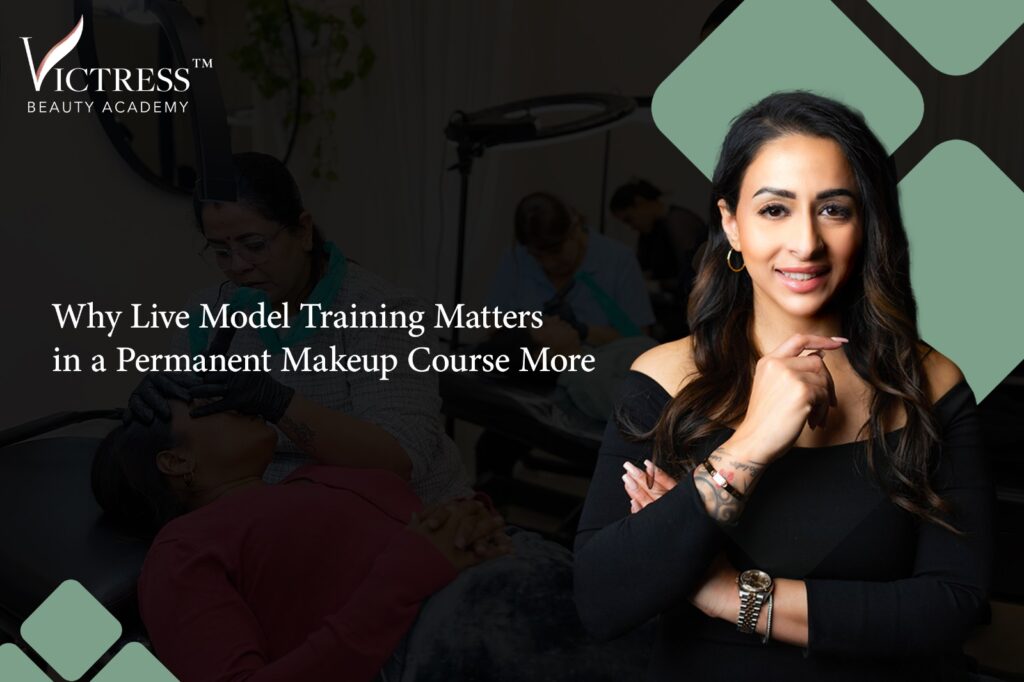
Why Live Model Training Matters in a Permanent Makeup Course
Practice skin has its place. It is where you learn to hold a machine, find a rhythm and draw a clean line without worrying about hurting anyone. Every artist should spend hours on it.
But no one has ever built a career on latex. At some point you have to work on a person and the gap between the two is much wider than most students expect.
Here is what only live model training can give you.
What Practice Skin Cannot Teach
Latex and silicone behave nothing like human tissue. On practice skin there is:
- No fluid: Real skin produces blood and lymph as you work. It pools, dilutes your pigment and hides what you have just done and you have to keep working through it.
- No stretch: Human skin moves. Holding a correct three-point stretch is what controls your depth and you cannot learn it on a surface that does not shift.
- No resistance change: Practice skin feels the same everywhere. Real skin changes texture across a single brow.
- No pain response: Nobody flinches, tears up or asks you to stop.
- No healing: This is the important one. Latex holds whatever you put into it forever, so it never tells you whether your depth was right.
Practice skin builds muscle memory. It cannot build judgement.
Every Face Is Different And You Only Learn That On Faces
Take microblading as an example. On paper it is simple: fine strokes that mimic individual hairs. On practice skin every stroke stays crisp, which is why every student feels capable at the end of a latex session. Then you meet an oily brow with large pores, and those same strokes spread and blur into a soft shadow within a few weeks. Nothing was wrong with your hand. That skin was never a candidate for hairstrokes and it needed a powder or ombre approach from the start. Learning to make that call during the consultation, not after the healing, is why our microblading course puts you in front of real brows.
Skin type changes everything else too. Thin, mature skin bruises easily and takes pigment fast. Thick or textured skin needs more patience and often more passes.
Then there is everything a real client brings with them: scar tissue, sun damage, previous permanent makeup that has faded to an unexpected colour, uneven brow bones, asymmetry nobody has ever pointed out to them.
You cannot study your way to this. You have to see twenty different faces and start recognising patterns. Live models are where that begins.
The Client Is Part Of The Procedure
Half of this job happens before the machine is switched on.
On a live model you learn to take a medical history properly, to map a shape and get genuine approval before you start and to explain what will happen during healing so nobody panics on day five. You learn how to keep someone calm who is nervous and how to keep working steadily while they talk to you.
You also learn to say no. A model with an active skin condition, unrealistic expectations or work that needs removal first is a case you should decline and declining kindly is a skill in itself. Practice skin never asks you for anything you should refuse.
Healing Is The Only Honest Feedback You Will Ever Get
Work looks beautiful the moment you finish. Every artist’s first fresh result looks impressive, which is exactly why fresh results teach you so little.
Four weeks later, that same brow tells you the truth. Pigment placed too shallow will have largely gone. Placed too deep, it will have spread or turned cool. Only then do you find out whether your choices were correct and only a live model can give you that information.
This is why we track student work at 30, 60 and 90 days rather than photographing it at the end of the appointment and moving on.
What Good Live Model Training Actually Looks Like
Not all live model work is equal. When you compare courses, look for:
- An educator standing beside you, correcting your angle, depth and stretch while it is happening rather than reviewing your work afterwards.
- Full responsibility for the appointment, from consultation and mapping through to aftercare instructions, not just the machine work.
- Models who reflect your future clients, including a range of skin tones and skin types rather than the easiest cases available.
- Structured follow-up, where you review your own healed photographs with your educator and understand what to change next time.
- Proper hygiene throughout, because a model is a real person taking a real risk on a student and that deserves clinical standards.
A course that hands you a machine and a stranger without supervision is not live model training. It is an unsupervised procedure with a certificate attached.
Your Portfolio Starts Here
There is a practical benefit too. The models you work on during training become the first images in your portfolio and healed photographs of real people are what convince a paying client to book you.
You cannot photograph latex and expect anyone to trust it. This is why the quality of the live model work in your permanent makeup course directly affects how quickly you start earning afterwards.
How We Approach It
At Victress Beauty Academy, live model work sits at the centre of every course rather than being added at the end. Our students observe an educator-led demonstration first, then work on their own model under direct supervision, then review their healed results with the person who taught them.
The aim is simple. We would rather you make your first mistakes with an educator beside you than in front of a paying client.
If that is the kind of training you are looking for, speak to our team about the right course for you.
FAQs
Do I need to arrange my own live model?
Academies handle this differently, so always confirm before you book rather than assuming. If you are sourcing your own, friends and family are the obvious starting point, but a short post on your social media usually finds willing volunteers, since most people are happy to receive the service at a reduced rate. Give them the full consultation and healing information in advance so they know what they are agreeing to.
What happens if a live model's result does not go well?
This is exactly why supervision exists. Your educator is beside you throughout and steps in before a mistake becomes a problem, which is very different from discovering it afterwards. Any adjustment needed is handled within the training and the model is given the same aftercare guidance a paying client would receive. Nobody is left with unfinished work because a student was learning.
Can I use photographs of my training models in my portfolio?
Yes, provided you have written permission. Include a photograph consent clause in the form your model signs before the appointment and be specific about where the images may appear, including social media and your website. Ask separately about showing the face rather than the treated area alone, as many people are comfortable with one and not the other. Get this signed on the day, because chasing consent months later rarely works.